


“Is this stone what they say it is?” That’s the question most people are really asking when they ask for a gemstone certificate, and it’s the very question a gem report was made to answer. You’ll notice we say report rather than certificate, and that’s the laboratory’s own wording: a lab doesn’t certify a stone, it examines it, tests it and writes down what it finds. The result is a short document that tells you more than you’d think.
Once you know how to read one (and how to check it online), you’ll know a great deal, starting with the authenticity of your gem. What a report can’t do is tell you which stone to fall in love with, and that, happily, is the part we’re here for!
The first line to find is the identification. It tells you what the stone is (Natural Ruby, Natural Sapphire, Natural Spinel) and it tells you just as plainly if a stone was grown in a laboratory. It’s the line we love most, because red stones have fooled people for centuries: some of the most famous ‘Rubies’ in the world’s royal collections turned out to be Spinel, a gem we adore in its own right (and would happily set for you), but it’s not a Ruby. Today, a good lab settles that with a few standard tests, so rest assured: if the report says Natural Ruby, you’re holding a Ruby.
Gemstone origin only appears on a report where it moves the price. Burma or Mozambique for a Ruby, Kashmir or Sri Lanka for a Sapphire. And even then, the lab gives it as an opinion instead of fact, because two deposits can look remarkably alike under a microscope. Most reports don’t carry an origin, and honestly, a stone doesn’t need one to be beautiful.
You’ll see “no indications of heating” rather than a flat “unheated”, because the lab is reporting what its tests found or didn’t find (which is exactly the caution you’d want from a scientist). And don’t let the word “heated” put you off. Traditional heat treatment is widely accepted in the trade. The colour it brings out is stable, and some of the most gorgeous Sapphires and Rubies we’ve ever set were heated. Unheated stones are rarer, and rarity has its price (an unheated stone of the same beauty can cost double or triple), but rare isn’t the same as lovelier. What the treatment line does is tell you plainly which of the two you’re looking at, so you can decide with your eyes open. And honestly, we’d say to fall for the colour first.
Filling is another story altogether. Heat works with what’s already in the stone, bringing out the colour the Corundum had in it all along. Filling does the opposite. Glass or lead is melted into the cracks of a stone that was full of them, so part of what you’re admiring isn’t a gem at all, and that glass can cloud or break down over time, or with the heat of a jeweller’s torch. It’s not something we ever buy, set or sell at MADLY, and it’s exactly the kind of thing the treatment line is there to catch.
The lab’s name at the top of a report matters less than what’s written under it. A report only describes what the stone is and what has been done to it. Those facts don’t normally change from lab to lab, so two good labs will tell you the same thing about the same stone. Some labs look more closely than others, so rest assured, when you purchase a MADLY gemstone, any report that comes with it is from a lab we’ve chosen with care.
GIA is the name most people know, because GIA built its reputation on Diamonds and Diamonds are the most common gemstone in the world, so if you’ve been told to insist on a GIA certificate, that’s Diamond advice. Coloured gemstones have specialists of their own. Here in Singapore, the Nan Yang Gemological Institute (NGI) follows the approach of SSEF, one of the most rigorous labs in the world, and has been cited in gemmology textbooks. You may also see names such as Lotus Gemology, ICA GemLab, Gübelin, SSEF, AGL or GRS on a report, all of them very well respected.
Checking the authenticity of a report is easy too. Most carry a QR code or a report number you can look up on the lab’s website. If the lab doesn’t offer an online check, a quick call quoting the report number does the same job.
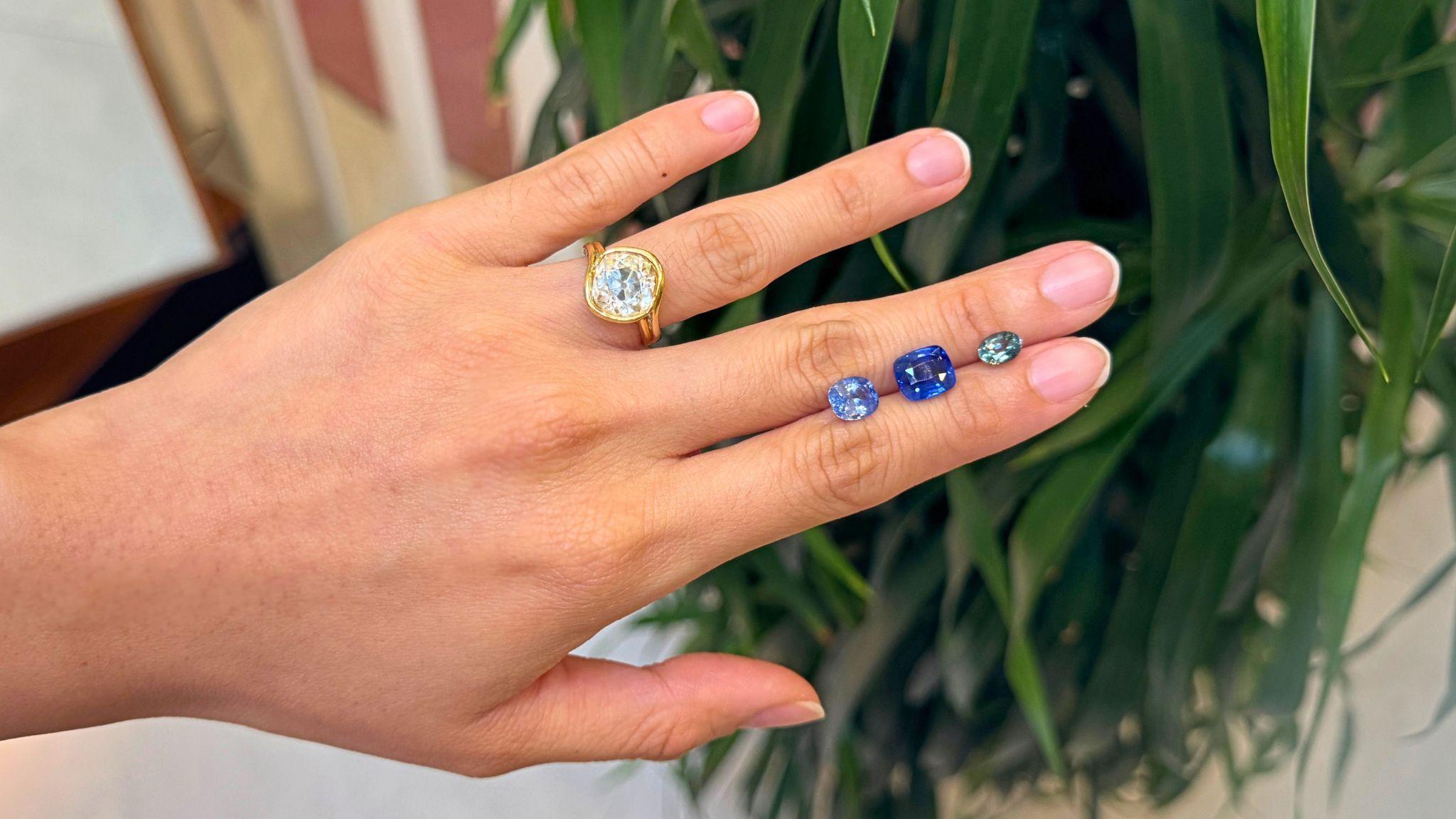
A report describes a stone. What it can’t tell you is how lovely that stone looks in your hand, whether its colour flatters your skin tone, whether it will sit well in the piece you have in mind, or whether you love it. And honestly, those are the things that matter most. Take colour. Ruby gets its red from traces of Chromium within Corundum, and a beautiful pure red is surprisingly difficult for nature to get right: too little Chromium and you’d get a pink Sapphire, too much and the stone darkens. A report will tell you the stone is red. It won’t tell you whether Mother Nature got that red right, let alone whether it’s the red for you.
The same goes for blue. Ask three of our clients for the perfect blue Sapphire and you’ll get three different stones: a soft cornflower, a deep royal blue, and a teal with flashes of green that no report would ever single out. None of them is wrong, and the right one is still the one you keep coming back to.
For the same reason, a report can’t tell you what a stone is worth. Price is decided by the stone, and above all by its colour, which is exactly the thing a report can only describe. A Diamond can be graded letter by letter from D downwards, but a coloured gemstone has no such scale, so two Sapphires with near-identical reports can sit at very different prices, and rightly so. Read the report for what it tells you about the stone, and then look at the stone, which is where we’d rather spend the appointment anyway.
A report is one half of your peace of mind. The rest comes from knowing how your jeweller chooses their stones. Here at MADLY, we work only with the top 0.1% of natural coloured gemstones, so rest assured that what you see at our showroom is the crème de la crème in colour, cut and clarity, and Singapore’s widest range of it too!
We’re the only jeweller in Singapore with our own sourcing office at the mines in Tanzania, and we have another in Sri Lanka. Many of our gems come to us as rough, straight from the source, to be cut in-house by our master lapidaries, so we know those stones from the very beginning and what they’ve been through since.
As the first jeweller in Singapore under the International Colored Gemstone Association’s Ethical Accreditation programme, we’ll tell you everything we know about your gemstone, from its treatment to where it came from. Every main stone valued at SGD 1,000 and up comes with a report from a reputable gemmological laboratory.
So if you have a stone and a report you’d like a second pair of eyes on, bring them along and we’ll read it together, and if you’re starting from scratch, that’s just as welcome. We’ll bring out the stones as we talk, read their reports with you, and then let you get back to looking, because that’s the part that matters. Whether you’re after Sapphire jewellery, Ruby jewellery or a natural coloured gemstone you’ve yet to meet, our showroom in Singapore is the place to see the stones, and their reports, for yourself.